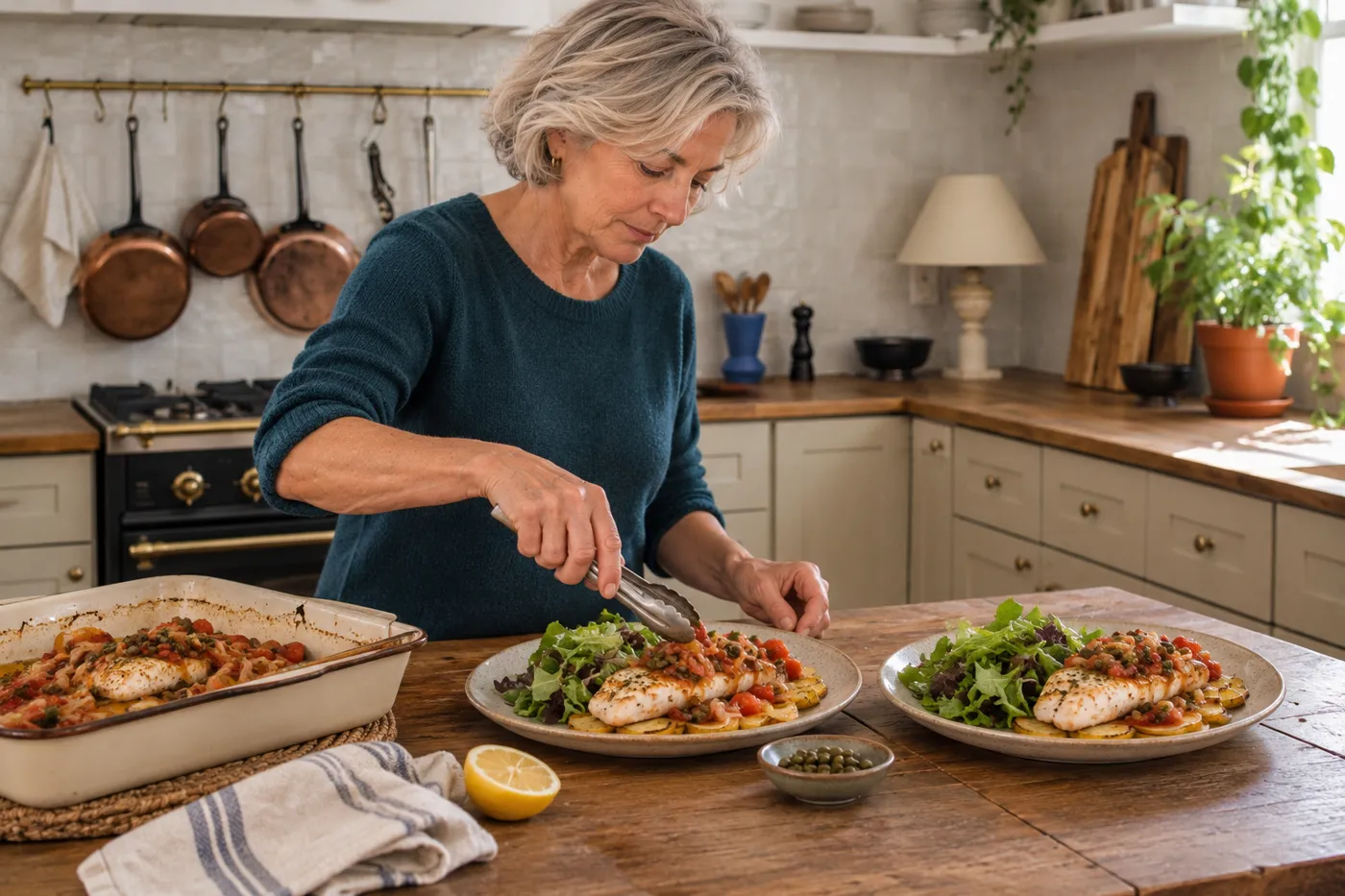
This plan has one goal: to help you eat well — varied meals, steady protein, and real pleasure — for four weeks. Most leftover days are light, but some cooking days involve several recipes and require extended preparation. Check the heavier days before each week begins. It runs across 28 days of simple, satisfying meals: each day brings a breakfast, a lunch, a dinner, one small snack, a serving of the previous night’s dessert on most days, and a freshly prepared dessert after dinner, averaging around 1,970 calories. Many lunches and dinners are cooked once and served again the next day, so there’s less time at the stove.

Week 1 opens with chicken piccata, then tuna pasta, a whole baked fish, and beef stew. Week 2 adds turkey meatballs, two fish dinners, and a lamb tagine; Week 3, tuna cakes, pork souvlaki, risotto, and roast chicken. Week 4 brings polenta, gnocchi, orzo, a quick shrimp-and-rice dinner, and freshly baked hake. Throughout the four weeks, lunch alternates between soup with a vegetable or bean dish and soup with a salad. Each week has its own shopping list, and the snacks to choose from come just before Week 1.
All 52 recipes appear in the four-week plan. The lunches and dinners include the salads and the fresh fish recipes.
Why about 2,000 calories a day
U.S. dietary guidance recognizes that energy needs vary with age, body size, activity, and health. Daily totals vary from about 1,670 to 2,240 calories, although the four-week average is about 1,970. These are estimates, not individual calorie or protein targets.
If you’re tall, active, or unintentionally losing weight, add a little more — an extra slice of bread, a fuller drizzle of olive oil, or a handful of nuts. If your doctor has asked you to eat less, scale down your portions. The plan bends to you.
Protein, spread throughout the day
Protein protects your muscles, and older bodies use it less efficiently than younger ones. International expert bodies — the PROT-AGE Study Group and the European Society for Clinical Nutrition and Metabolism (ESPEN) — recommend about 1.0 to 1.2 grams of protein per kilogram of body weight a day for healthy older adults, more than the long-standing minimum of 0.8. Spreading it across meals is a practical approach, though the best split is still being studied. So this plan places protein at every main meal and in most snacks; most desserts add protein too. Fruit salad is light on protein; a few nuts or a spoonful of yogurt beside it adds a little.
Some older adults find smaller, more frequent meals easier to manage, especially when appetite is low. This is an example plan, not an individual nutrition prescription. If you have kidney disease, diabetes, or take medications that affect dietary needs, ask your healthcare team to review it before starting. If you take warfarin, keep your vitamin K intake consistent and discuss major dietary changes with your clinician.

A word about salt
Cooking at home is one of the most effective ways to manage salt intake. More than 70% of the sodium most Americans eat comes from packaged and restaurant food — not from the home kitchen or the salt shaker. The recipes here are seasoned with a careful hand. The American Heart Association recommends no more than 2,300 mg of sodium a day, and ideally closer to 1,500 mg for older adults. Daily sodium on this plan varies with the brands of broth, bread, cheese, and canned foods you buy, so check the labels and the sodium figure on each recipe.
At the same time, food has to taste good for you to keep eating it — and a little salt is part of that, especially when eating enough is the real priority. So these recipes use salt thoughtfully, not fearfully. If your doctor or cardiologist has placed you on a low-sodium diet, or if you live with high blood pressure, heart failure, or kidney disease, follow their guidance first and season more lightly. The sodium figures in the nutrition tables do not include salt added to taste. Among the snacks, olives, feta, and cheese are flavorful but salty, so keep those portions small — a few olives, a thin slice of cheese.
Sources: The nutrition targets in this plan draw on the Dietary Guidelines for Americans (USDA & HHS), protein recommendations from the PROT-AGE Study Group and ESPEN, sodium guidance from the American Heart Association, and side-dish calorie data from the USDA’s FoodData Central. This book is not medical advice; talk with your doctor about your individual needs.
A comfortable daily rhythm
| Time | Meal |
|---|---|
| 7:30 a.m. | Breakfast |
| 10:00 a.m. | Snack — or at 4:00, as you like |
| 1:00 p.m. | Lunch — soup with a vegetable or bean dish, or a Chapter 3 salad |
| 4:00 p.m. | Last night’s dessert — or the snack |
| 6:30 p.m. | Dinner — a pasta or grain dish, or a fish or meat plate, followed by dessert |
Choose a dinner time and portion that suit your appetite, daily routine, and medical needs. Eating earlier is fine.
The timing above is a practical rhythm, not a medical prescription — designed to spread protein and energy evenly through the day. Adjust the times to fit your routine.
Snacks — one from the lists, one from last night’s dessert
Each recipe in this book yields two servings, and desserts are no exception — so the day has one snack and last night’s dessert between meals; eat either one in the morning and the other in the afternoon, as you like. The snack is one of the options in the Snacks section a few pages on, about 100 to 150 calories. Each day names one, chosen to keep that day’s calories and protein on target, and you can swap it for any other on the list — the shopping lists buy the named ones, so check that you have what a swap needs. Most options include a protein anchor — yogurt, nuts, cheese, or hummus. Last night’s dessert — desserts are planned in pairs, so the next day usually uses what was made the evening before; follow the amount shown for each day. Nothing is wasted, and the fresh-fruit desserts (fruit salad, yogurt with fruit) are eaten when they’re at their best. For a fruit salad eaten over two days, chill half the fruit separately before adding the banana (or kiwi), and slice the other half of the banana into it the next day. On the very first day, there’s no dessert from “yesterday,” so Day 1 has a second snack from the Snacks section.
Cook once, eat twice.
Every recipe makes two servings, and the day shows how much to make (full, ½, or ¼). On a “cook today” day, make that amount and eat one serving; any second serving becomes your “from yesterday” meal the next day. You cook just once and eat from it twice — no doubling, no extra math. No recipe appears three days running: after its two days, something else takes its turn. Most lunches and dinners work this way, and many dishes taste even better the second day. Soups, stews, and bean dishes reheat especially well; pasta and rice soften a little. A ½ before a dish means half of one serving; “½ recipe” after it means make half the recipe. If two days in a row each call for ½, make half the recipe and divide it between them.
If your schedule changes
If a day doesn’t go as planned — you eat out, a friend visits, or you don’t feel like cooking — nothing breaks. Cooked dishes keep safely in the refrigerator for three to four days; reheat until steaming hot (165°F). A meal meant for Tuesday is just as good on Wednesday.
Refrigerate all perishable leftovers within 2 hours of cooking, or within 1 hour when the temperature is above 90°F. Divide large amounts into shallow containers. Keep the refrigerator at 40°F or below. Reheat cooked leftovers to 165°F; use within 3–4 days or freeze sooner.
Freeze meat and seafood that will be used later in the week. Move each frozen portion to the refrigerator the night before its scheduled meal. Check the dated thawing reminder in the weekly preparation notes.
Cooked fresh, not carried over
Fish or seafood comes twice a week, close to the American Heart Association’s advice of two fish servings a week (shrimp counts as seafood, not fish). The weekly notes explain the whole-fish portions and the tuna cakes’ extra serving to freeze. A few one-day pasta dishes leave room for all the fish recipes, while paired meat, risotto, and polenta dinners keep the cook once, eat twice rhythm.
Every recipe makes two servings, but the plan is built for one person
This plan and its shopping lists are sized for one person. Follow the exact recipe fraction printed for each meal. For two people, double the shopping quantities and every cooking amount; when saving a meal for the next day, prepare enough for both people on both days.
Breakfasts are the one-day exception — cook for one and make half the breakfast recipe, unless a smaller portion is shown. On those days, make a quarter of the recipe. When a recipe uses only egg yolks or only whites, keep the other part covered in the refrigerator and use it within 2 to 4 days — the almond cookies (8.03) take a white; for half a batch, beat it lightly with a fork and use half. Freeze any whites you won’t use by then in an ice-cube tray; they keep for months.
What matters most is your weekly intake
Keep the soup at lunch when you change the salad or vegetable dish. Choose a similar portion, and let it take the place of the planned dish. Your weekly intake matters most, so enjoy the rhythm of the week without expecting every day to be the same.
A few familiar breakfasts and desserts return to simplify shopping: desserts after at least four days, and three breakfasts about weekly. Swap within Chapter 8 or Chapter 1 and update your shopping list. A new dessert’s second serving replaces the next afternoon’s dessert.
Daily calories and protein describe the planned dishes; swaps change them. Choose a yogurt or cheese snack if a swap is lighter in protein. Check heavier cooking days before each week; follow the preparation notes to make suitable dishes ahead and refrigerate promptly.
A note for family and caregivers
If you’re reading this on behalf of a parent or someone you care for, this plan was designed with you in mind, too. It is not designed as a crash diet and requires no special cooking skills. The “cook once, eat twice” rhythm keeps effort and waste low. Each week’s shopping list is organized by store aisle and ready to give to whoever does the shopping — you, a family member, or a grocery delivery service.
When in doubt about calories, salt, or protein for a specific health condition, check with their doctor first. The plan averages about two eggs a day; if their doctor limits eggs, swap egg breakfasts for yogurt (1.03) or semolina (1.05) and skip the egg desserts.
How each meal is built
Lunch starts with a bowl of soup. Beside it, the plan alternates a vegetable or bean dish from Chapter 5 with a salad from Chapter 3. These are the lunch salads, so you do not need another full salad beside dinner. For fresh salads, follow the fraction printed for the meal: half a serving means a quarter of the recipe. Eat the salad fresh. The carrot and orange salad, tahini bean salad, and potato salad keep well for tomorrow.
For dinner, a pasta or grain dish from Chapter 4 stands on its own. With fish or meat, add a small green salad — two cups of leaves with a teaspoon of olive oil and a squeeze of lemon — to fill half the plate, as in Chapter 9. The Chapter 3 salads already come with lunch, so there is no second one at dinner.
You do not need to add bread, potatoes, rice, or a dip to these dinners. Where the recipe already includes potatoes, rice, or tzatziki, they are part of the plate. The SERVE WITH line under each recipe is there for the days you cook outside this plan. When you buy pasta, couscous, or bread, whole-grain versions add fiber — choose them whenever you like.
Equipment: soups 2.01, 2.02, and 2.05 are puréed with a stick (immersion) blender — off the heat, with the blender head under the surface, right in the pot; switch it off before lifting, or simply mash. Never pour hot soup into a jug blender.